

In today’s competitive hospitality industry, hotel owners and operators must make strategic decisions to balance guest comfort, aesthetics, and operational efficiency. One of the most important in-room considerations is whether to install a minibar or a hotel refrigerator. While both appliances serve to keep beverages and snacks cool, their functions, features, and ideal applications differ greatly. Choosing the right one can enhance guest satisfaction, reduce operational costs, and reflect the overall positioning of your hotel brand.
A mini bar unit is a compact refrigeration appliance typically placed inside a guestroom cabinet or furniture enclosure. It is designed primarily for offering chilled beverages and snacks that the hotel provides, often as part of a premium or chargeable service. Mini bars usually have a smaller capacity—between 15 and 40 liters—and focus on elegance, quiet operation, and energy efficiency.
In high-end hotels, the minibar is considered a key element of personalized service. Guests can conveniently access refreshments without leaving their room, which enhances the overall sense of comfort and luxury. Many modern minibars are equipped with silent cooling systems and advanced temperature control to ensure an enjoyable experience without unwanted noise. They can also be customized with different finishes, colors, or branding to match the interior design of the room.
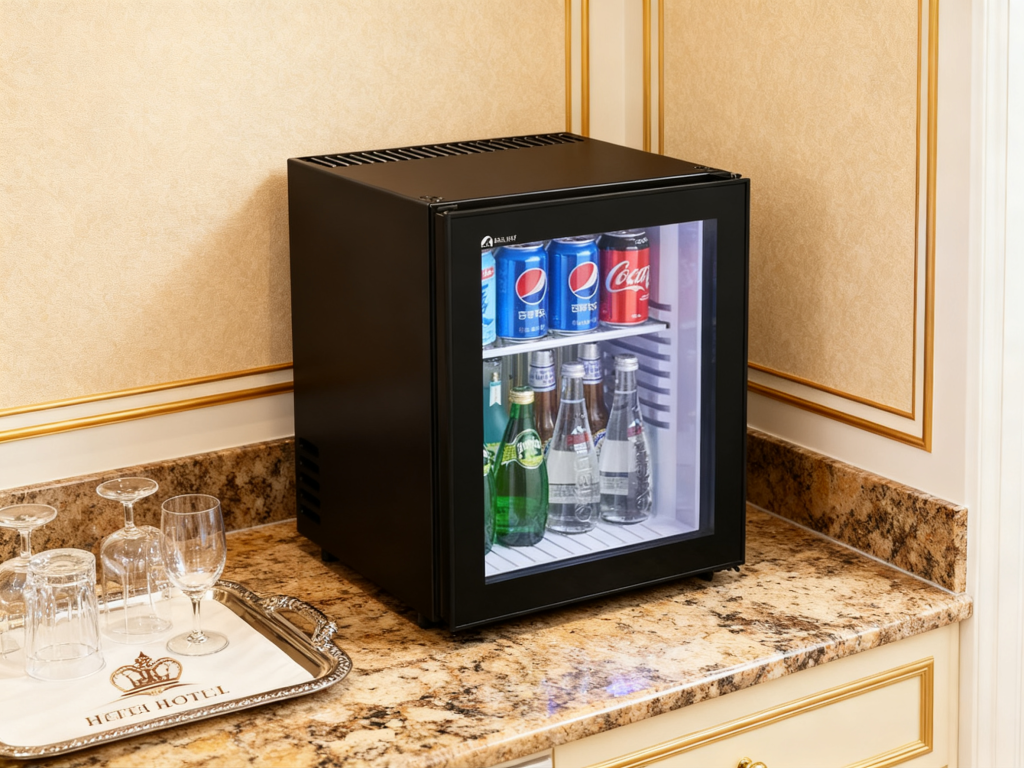
A hotel refrigerator, on the other hand, is a more versatile appliance that allows guests to store their own food and beverages. It is designed for functionality, practicality, and flexibility, offering more space and a variety of configurations—such as glass-door models, drawer types, wall-mounted units, or traditional under-counter styles.
Unlike minibars, hotel refrigerators are not necessarily stocked by the hotel. Instead, they provide guests with the convenience of personal storage, making them ideal for business travelers, families, or long-stay guests. They are typically built with strong insulation and energy-efficient compressors, ensuring reliable cooling performance while minimizing energy consumption.

Mini bars are meant to enhance the luxury and convenience of a hotel stay by offering pre-stocked refreshments. Hotel refrigerators focus on guest independence, giving travelers the ability to store their own items.
Mini bars are compact and aesthetically integrated into the room’s furniture, while hotel refrigerators are generally larger and designed to accommodate a wider variety of products.
Both appliances emphasize quiet operation, but minibars are usually optimized for near-silent performance, which is important in luxury rooms. Hotel refrigerators, being larger, may produce slightly more sound but often feature improved insulation and energy-saving systems.
Mini bars require more maintenance, including restocking and monitoring consumption, which can increase staff workload but also generate additional revenue. Hotel refrigerators require minimal management since guests handle their own storage, reducing operational effort.
Mini bars create a premium impression, offering curated luxury and convenience. Hotel refrigerators, however, cater to practicality and comfort, making them a better fit for hotels that emphasize a homelike or extended-stay experience.
Understanding your target audience is key. Luxury or boutique hotels that prioritize exclusivity and personalized service will benefit from installing minibar units. They change the guest experience and can also become a profitable amenity through sales. In contrast, business hotels, family resorts, and serviced apartments often find hotel refrigerators more suitable due to their versatility and guest autonomy.
Room space plays an important role in the decision-making process. Mini bars are ideal for compact guest rooms where every inch of space matters, as they can be easily built into furniture. Hotel refrigerators, with their larger capacity, are more appropriate for spacious rooms or suites where additional convenience is expected.
Mini bars can provide an additional revenue stream but require frequent inventory checks and maintenance. Hotel refrigerators involve less daily management but may consume slightly more power depending on the model and usage. Carefully comparing the long-term costs and benefits will help you determine which option aligns best with your hotel’s operational goals.
Modern refrigeration technology focuses heavily on energy efficiency and environmental performance. Whether choosing a mini bar or a hotel refrigerator, it is wise to select models with low power consumption, eco-friendly refrigerants, and quiet operation. These factors not only enhance guest comfort but also support your hotel’s sustainability initiatives and reduce energy bills.
Deciding between a mini bar and a hotel refrigerator depends on your property’s positioning, guest preferences, and operational strategy. Mini bars create a sense of luxury, offering guests the pleasure of convenience and indulgence. Hotel refrigerators, by contrast, provide practicality, allowing guests to store personal items and enjoy more flexibility during their stay.
So, the right choice should align with your hotel’s brand identity and service philosophy. By selecting the appropriate refrigeration solution—whether a sleek mini bar for a boutique setting or a versatile refrigerator for long-term guests—you can enhance guest satisfaction, improve efficiency, and strengthen your overall hospitality offering.
Recent postsLearn More
Wellway was founded in 1997 and is the first company in China to use diffusion-absorption refrigeration technology to manufacture and sell hotel refrigerators. After years of hard work, we have launched minibar products with various refrigeration methods such as absorption, compressor and semiconductor.
Contact Us