

In the modern hospitality industry, guest expectations continue to rise, and hotels are expected to deliver both comfort and convenience in every aspect of the stay. Among the essential in-room amenities, the guest room refrigerator plays a critical yet often underestimated role. From preserving beverages at the ideal temperature to supporting longer guest stays, hotel guest room fridges have evolved into a strategic investment that impacts guest satisfaction, operational efficiency, and brand perception.
For hotel owners, developers, and procurement managers, selecting the right refrigerator is no longer a matter of size alone. Today’s hotel refrigeration solutions must combine advanced technology, quiet performance, energy efficiency, and design adaptability to meet the demands of diverse hospitality environments.
A well-designed guest room fridge directly contributes to comfort and convenience. Guests expect to store chilled drinks, personal food items, or temperature-sensitive products without disruption. Whether in business hotels, resorts, serviced apartments, or boutique properties, a reliable refrigerator enhances the feeling of being at home while traveling.
Equally important is the operational aspect. Hotel refrigerators must operate quietly, especially in sleeping areas. Excessive noise can negatively affect guest reviews, while inconsistent cooling can lead to complaints and increased maintenance costs. As a result, hospitality-grade refrigerators are specifically engineered to balance performance with comfort.
Modern hotel guest-room fridges use a variety of refrigeration technologies to suit different hotel needs. Compressor-based systems provide stable and powerful cooling for properties with higher usage demands. Absorption and semiconductor technologies are often chosen for their near-silent operation, making them ideal for premium rooms and noise-sensitive environments.
These technologies are designed to maintain consistent internal temperatures while minimizing energy consumption. Energy efficiency is especially important for hotels managing hundreds or thousands of rooms, where even small savings per unit can translate into remarkable long-term cost reductions.
Guest room layouts vary greatly across hotel types, and refrigeration solutions must adapt accordingly. Compact mini bar refrigerators are widely used due to their ability to fit well under desks, inside cabinets, or within custom furniture. Their small footprint allows hoteliers to maximize usable space without sacrificing functionality.
Wall-mounted refrigerators provide an additional space-saving solution, especially for smaller rooms or extended-stay properties. By freeing up floor space, these units contribute to a cleaner, more organized room layout while maintaining easy guest access.
The choice of refrigerator door material is an important consideration for hotel procurement teams. Plastic door refrigerators offer lightweight construction, corrosion resistance, and ease of maintenance, making them suitable for cost-conscious projects or humid environments.
Iron door refrigerators, on the other hand, are valued for their durability and solid feel. These models are often selected for high-traffic hotels where long-term reliability and resistance to frequent use are essential.
Glass door refrigerators are increasingly popular in hospitality settings where visibility and presentation matter. Allowing guests to view contents without opening the door, these designs help reduce cold air loss and improve energy efficiency while adding a modern aesthetic.
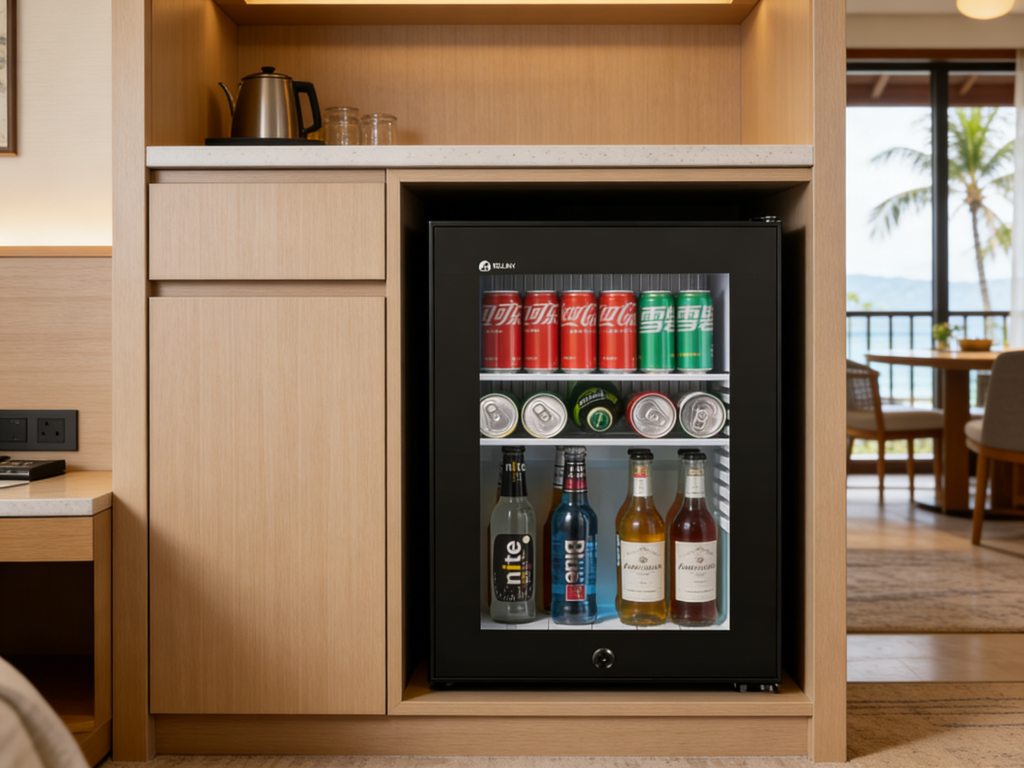
Beyond performance, aesthetics play a growing role in guest room appliance selection. Today’s hotel refrigerators are available in a wide range of finishes, colors, and styles, including retro-inspired designs for boutique and lifestyle hotels. These design options allow hoteliers to align appliances with interior themes and brand identity.
Customization and OEM/ODM capabilities further support branding efforts. From logo placement to color matching, the refrigerator solutions help hotels maintain visual consistency across rooms and properties.
Hospitality refrigerators are designed for continuous use and must meet strict quality and safety standards. Durable components, stable cooling systems, and thorough quality control processes ensure long service life and reduced maintenance requirements. For hotel operators, this translates into lower total cost of ownership and fewer disruptions to daily operations.
Reliable refrigeration equipment also supports sustainability goals by reducing waste caused by temperature fluctuations or product spoilage.
Hotel guest room fridges have become an integral part of the modern hospitality experience. By combining advanced refrigeration technology with thoughtful design and quiet operation, these appliances enhance guest comfort while supporting hotel efficiency and branding goals.
For B2B hotel procurement professionals, investing in the right guest room refrigerator is a strategic decision — one that balances performance, durability, energy efficiency, and design flexibility. As guest expectations continue to evolve, well-chosen refrigeration solutions help hotels deliver consistent quality, comfort, and value in every stay.
Recent postsLearn More
Wellway was founded in 1997 and is the first company in China to use diffusion-absorption refrigeration technology to manufacture and sell hotel refrigerators. After years of hard work, we have launched minibar products with various refrigeration methods such as absorption, compressor and semiconductor.
Contact Us