

In-room refrigeration has become a standard yet highly strategic component of modern hotel room design. For hospitality engineering and procurement teams, selecting the right hotel in-room fridge involves far more than choosing a compact appliance. Noise control, energy efficiency, installation flexibility, durability, and guest experience all play a critical role in determining long-term operational success.
Whether for business hotels, luxury resorts, or extended-stay properties, well-selected in-room refrigerators can enhance guest satisfaction while controlling maintenance and energy costs across large room inventories.
From a guest’s perspective, a hotel refrigerator is a convenience feature that supports comfort, personalization, and practicality. Guests expect reliable cooling for beverages, snacks, and personal items without disruptive noise or visual clutter.
For engineering teams, this translates into the demand for refrigerators that deliver consistent temperature performance, operate quietly throughout the night, and integrate naturally into guestroom furniture layouts. Poorly chosen units can lead to guest complaints, excessive service calls, and higher energy consumption over time.
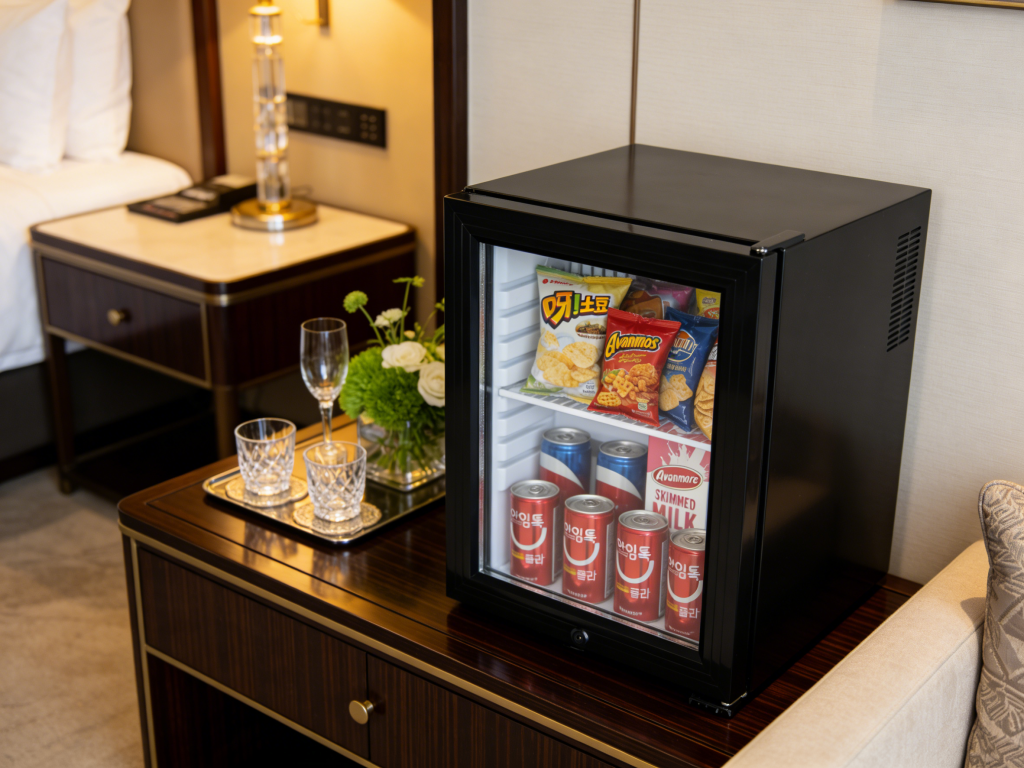
Compact mini bar refrigerators are the most common solution for standard hotel rooms. Designed specifically for hospitality use, these units balance small footprints with reliable cooling performance.
Typical compact models range in capacity from approximately 14 to 40 liters, making them suitable for under-counter, cabinet, or freestanding installation. Quiet operation is a defining requirement, ensuring refrigerators do not interfere with sleep quality. Advanced cooling systems allow these units to maintain stable temperatures while keeping vibration and sound levels extremely low.
Energy efficiency is another key consideration. Low-power consumption refrigerators help hotels meet sustainability goals while reducing operating expenses across hundreds or thousands of rooms.
For suites, executive rooms, and extended-stay accommodations, larger-capacity in-room refrigerators provide added value. These rooms often host guests for longer durations, increasing the frequency of food and beverage storage.
Mid-size in-room refrigerators offer increased interior space without dramatically increasing installation complexity. Adjustable shelving and temperature control options allow flexibility for different guest usage patterns. These models are particularly well-suited for serviced apartments and long-stay hotels where guest self-sufficiency is a priority.
From a procurement standpoint, these units provide a strong balance between enhanced functionality and manageable lifecycle costs.
Glass door in-room refrigerators are increasingly popular in upscale hotels and premium room categories. By allowing guests to view contents without opening the door, these refrigerators help maintain internal temperature stability and reduce energy loss.
Visually, glass door units enhance the overall aesthetic of the room, especially when stocked with curated beverages or minibar offerings. They are commonly used in luxury hotels, lifestyle properties, and rooms where minibar presentation contributes to brand positioning.
For engineering teams, these refrigerators offer the added benefit of reduced door openings, which can contribute to lower energy usage and improved compressor longevity.
Drawer-style and built-in refrigerators are designed for properties that prioritize minimalist aesthetics and furniture integration. Installed directly into cabinetry or under counters, these units preserve clean lines and maximize usable floor space.
This style is particularly well-suited for luxury suites and high-end hospitality environments where visual harmony and space efficiency are essential. Despite their discreet appearance, these refrigerators are engineered to deliver reliable cooling performance and quiet operation.
Engineering teams should evaluate ventilation requirements and cabinet compatibility to ensure optimal performance over the product lifecycle.
When selecting hotel in-room refrigerators, hospitality engineering teams should evaluate several technical factors:
Noise levels are critical, as even minor vibration can impact guest comfort. Low-decibel operation should be a baseline requirement.
Energy efficiency directly affects long-term operating costs. Refrigerators designed for hospitality environments typically focus on stable performance with minimal power draw.
Installation flexibility allows refrigerators to be adapted to different room layouts, including freestanding, under-counter, wall-mounted, or built-in configurations.
Durability and ease of maintenance reduce service downtime and replacement costs. Hospitality-grade refrigerators are built to withstand continuous operation and frequent guest use.
Different hotel segments benefit from different in-room fridge configurations. Business hotels typically prioritize compact, ultra-quiet refrigerators with low energy consumption. Luxury and boutique hotels often select glass doors, drawer-style, or design-forward units that enhance room aesthetics. Extended-stay hotels require larger-capacity refrigerators that support longer guest occupancy.
By aligning refrigerator selection with property positioning and guest expectations, hotels can optimize both guest satisfaction and operational efficiency.
Hotel in-room refrigerators may appear to be small components of guestroom design, but their impact on comfort, efficiency, and operational cost is distinct. For hospitality engineering and procurement teams, thoughtful fridge selection supports long-term performance, reduces maintenance challenges, and enhances the overall guest experience.
By focusing on quiet operation, energy efficiency, installation adaptability, and durability, hotels can ensure their in-room refrigeration strategy delivers measurable value across the entire property portfolio.
Recent postsLearn More
Wellway was founded in 1997 and is the first company in China to use diffusion-absorption refrigeration technology to manufacture and sell hotel refrigerators. After years of hard work, we have launched minibar products with various refrigeration methods such as absorption, compressor and semiconductor.
Contact Us