

In modern hospitality projects, guest room appliances are no longer considered secondary details. Among them, the hotel mini fridge plays a critical role in shaping guest comfort, supporting operational efficiency, and reinforcing a hotel’s brand image. For hotel owners, developers, and procurement managers, choosing a mini fridge that meets hospitality standards requires a careful balance of performance, durability, energy efficiency, and design compatibility.
This article explores the key factors to consider when selecting hotel mini fridges, helping B2B buyers make wise decisions for different property types and room categories.
A hotel mini fridge is more than a storage unit for beverages. It contributes directly to a guest’s perception of convenience, comfort, and service quality. Whether used to store minibar items, personal drinks, or essential refreshments, a reliable mini fridge enhances the in-room experience and reduces friction during a guest’s stay.
Inconsistent cooling, excessive noise, or poorly integrated design can quickly lead to guest dissatisfaction. As online reviews increasingly influence booking decisions, hotels must ensure that even small appliances meet professional hospitality expectations.
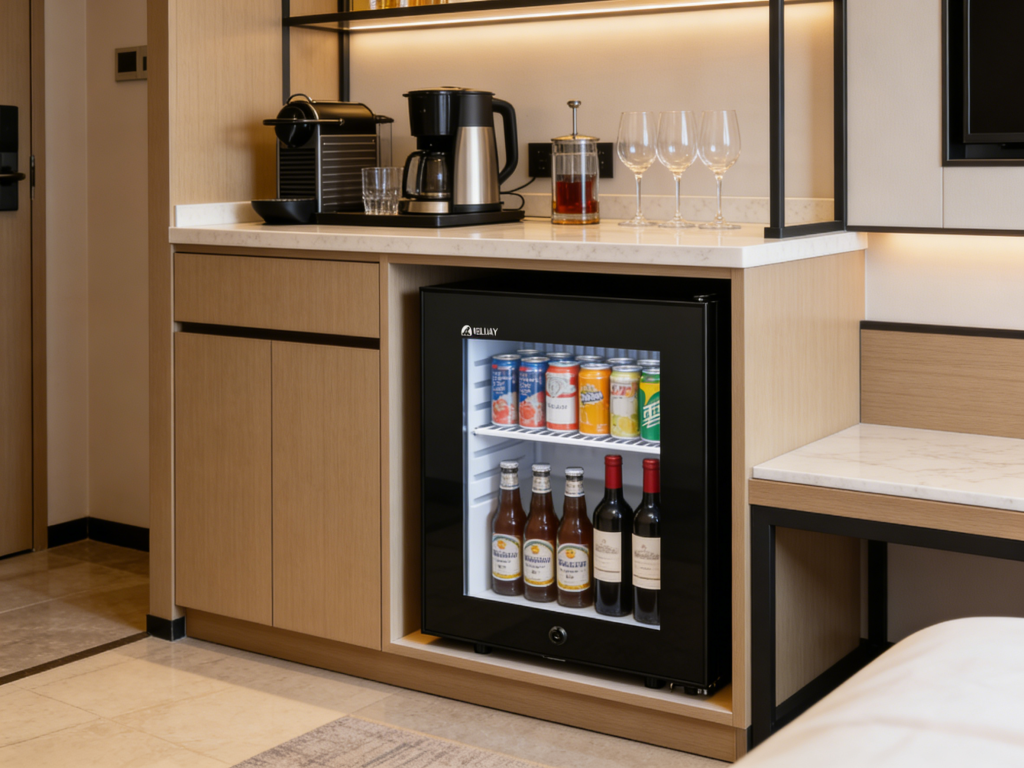
Hotels operate across a wide range of room sizes, guest profiles, and design concepts. As a result, there is no single mini fridge solution that fits every scenario. Selecting the right type depends on how the unit will be used and where it will be installed.
Smaller-capacity mini bar refrigerators are commonly used in standard guest rooms where space efficiency is a priority. These models are designed to fit perfectly under desks, inside cabinets, or within custom furniture. Despite their compact size, they provide sufficient storage for bottled drinks, snacks, and minibar items.
Compact units are especially suitable for business hotels, city hotels, and high-density properties where maximizing usable space is critical.
Mid-size and larger mini fridges offer increased storage capacity, making them ideal for suites, long-stay rooms, or hotels catering to guests who expect more in-room amenities. These refrigerators allow guests to store fresh items and multiple beverages comfortably, improving convenience during longer stays.
For procurement teams, these models offer flexibility across room tiers while maintaining consistent performance and appearance throughout the property.
Glass door hotel refrigerators are increasingly popular in modern and boutique hotel environments. By allowing visibility of contents without opening the door, these units help reduce cold air loss and improve energy efficiency. They also enhance presentation, making them suitable for curated minibar offerings.
In addition, specialty designs such as retro-style refrigerators or wall-mounted units offer creative solutions for hotels seeking distinctive interior aesthetics or space-saving installations. These options allow hotels to align appliances with overall room design and brand identity without sacrificing functionality.
Noise control is one of the most critical hospitality standards for in-room appliances. Mini fridges designed for hotel use prioritize low-noise operation to ensure guests are not disturbed during rest or work. This is particularly important in compact rooms where the refrigerator is positioned close to the bed.
Energy efficiency directly impacts a hotel’s operating costs, especially when refrigerators run continuously across hundreds of rooms. Hotel-grade mini fridges are designed to balance stable cooling performance with low energy consumption, helping properties manage utility expenses and sustainability goals.
Consistent temperature control ensures that beverages and food items are kept fresh and safe. Adjustable temperature settings allow hotels to adapt refrigerator performance based on minibar offerings or guest usage patterns.
Hotel mini fridges must withstand frequent use over extended periods. Durable construction materials, solid door designs, and reliable internal components reduce maintenance requirements and extend product lifespan.
From a procurement perspective, investing in hotel-grade refrigerators minimizes replacement cycles and service disruptions, resulting in lower total cost of ownership over time.
Modern hotel rooms demand appliances that integrate naturally into the overall interior layout. Mini fridges should complement furniture design, cabinetry, and room flow rather than disrupt it.
Flexible installation options—such as built-in placement, under-counter designs, or wall-mounted configurations—allow hotels to optimize space while maintaining accessibility for guests and housekeeping staff.
Selecting a hotel mini fridge is not simply a purchasing decision; it is a strategic investment. The right product supports guest satisfaction, operational efficiency, and brand consistency across the property.
By focusing on quiet performance, energy efficiency, appropriate capacity, and design compatibility, hotel procurement teams can ensure that mini fridges meet hospitality standards while supporting long-term business objectives.
Choosing a hotel mini fridge that meets hospitality standards requires careful evaluation of both guest expectations and operational needs. From compact minibar refrigerators to larger-capacity and specialty design options, the right choice depends on room type, guest profile, and overall hotel positioning.
For B2B buyers, prioritizing hotel-grade performance, durability, and design integration ensures that mini fridges contribute positively to the guest experience while delivering reliable value over the lifecycle of the property.
Recent postsLearn More
Wellway was founded in 1997 and is the first company in China to use diffusion-absorption refrigeration technology to manufacture and sell hotel refrigerators. After years of hard work, we have launched minibar products with various refrigeration methods such as absorption, compressor and semiconductor.
Contact Us